%20no%20bgr.png)
The 2025 GEO Revolution: Inside the Proven Traction of AI's New Search Paradigm
- Jul 8, 2025
- 6 min read
Updated: Jul 9, 2025
Let's Start With Key Findings
After spending many nights analyzing the latest research and observing the digital marketing landscape transform, I can say with certainty: we are experiencing the most significant shift in search behaviour since Google first launched. What I’m about to share is not just theory—it’s backed by hard data that should make every business owner reconsider their approach.
Here's what caught my attention first: AI search traffic isn't just growing—it's exploding at a rate that's 165 times faster than traditional organic search. When I first saw these numbers, I had to double-check them. But the data doesn't lie, and what we're witnessing is nothing short of revolutionary.

Now, let’s make it clear: the research confirms that common channels—like direct, organic search, referral, and paid—are not dead. They still dominate the digital traffic landscape. But generative AI is actively writing a new story.
Let's discuss what this means for businesses.
Here's What We're Really Dealing With
You might not realize it, but ChatGPT now processes 1 billion searches every day. To put this in perspective, that's roughly 7% of Google's massive 14 billion daily searches—achieved in just two years since launch. As you may guess, this kind of growth doesn't happen by accident.

Remarkably, ChatGPT reached 1 million users in just five days. For comparison, Instagram took 2.5 months and Netflix 3.5 years to reach the same milestone. This highlights the magnitude of the current shift.
But here's the kicker: AI search traffic has increased 970% year-over-year (YoY), while traditional search traffic has dropped approximately 21% in the same period. It is unsurprising that smart marketers are scrambling to understand this new landscape.
The Reality That's Changing Everything
Let me share something that might shock you: zero-click searches now account for 58-65% of all Google searches. This means most users are getting their answers directly from search results, without ever clicking through to websites.
Here's what's even more remarkable—this figure is projected to exceed 70% globally by mid-2025 (which is approximately now). Google's AI Overviews, which launched in May 2024, now appear in over 11% of queries. From January to March 2025 alone, the share of queries displaying AI Overviews jumped from 6.49% to 13.14%. That's a staggering 72% growth in just two months.
Let's Define What GEO is
When the world first heard about Generative Engine Optimization (GEO), many were skeptical, dismissing it as just another marketing buzzword. But after diving deep into the Princeton University research published in 2024, I realized this isn't just a trend—it's a fundamental shift in how we need to approach content creation.
Here's a simple GEO explanation: while traditional SEO optimizes for clicks and rankings, GEO optimizes for citations and mentions within AI responses. It's the difference between trying to get people to visit your house versus having your expertise quoted at dinner parties across town.
The Most Effective GEO Pillars
Through experimentation and analysis of various campaigns, three core principles were identified that consistently deliver results:
Contextual Relevance That Matters. AI systems don't just look for keywords—they understand context, relationships, and meaning. After shifting from keyword stuffing to creating genuinely comprehensive, contextually rich content, the difference in AI citations was remarkable.
Structure That Machines Can Actually Parse. AI systems love clear headings, concise summaries, and structured data. But it goes deeper than basic formatting. Custom metadata specifically designed for AI processing makes a significant difference in citation frequency.
Authority That AI Systems Recognize. This one is interesting. AI platforms are incredibly sophisticated at identifying credible sources. The old E-E-A-T principles (Experience, Expertise, Authoritativeness, Trustworthiness) aren't just important—they're absolutely critical for GEO success.
The Techniques That Move the Needle
Now, let's discuss the specific strategies that deliver real results. Princeton University's GEO-bench benchmark revealed some fascinating insights that align perfectly with market observations:
What Works Best:
Statistics Addition: Consistently seen 40% visibility improvements when incorporating relevant data
Citations and Quotations: Adding authoritative sources typically delivers 35-40% better performance
Authoritative Content Optimization: Focusing on expertise and credibility usually results in a 25-30% improvement

AI Platform Preferences
Here's a fascinating finding: different AI platforms have distinct citation preferences, requiring adaptation for each model.
ChatGPT's Behaviour Patterns: analysis shows a strong preference for Wikipedia (47.9% of top citations), followed by academic sources, news publications, and professional websites. Understanding this hierarchy has completely changed how one should approach content creation for AI visibility.
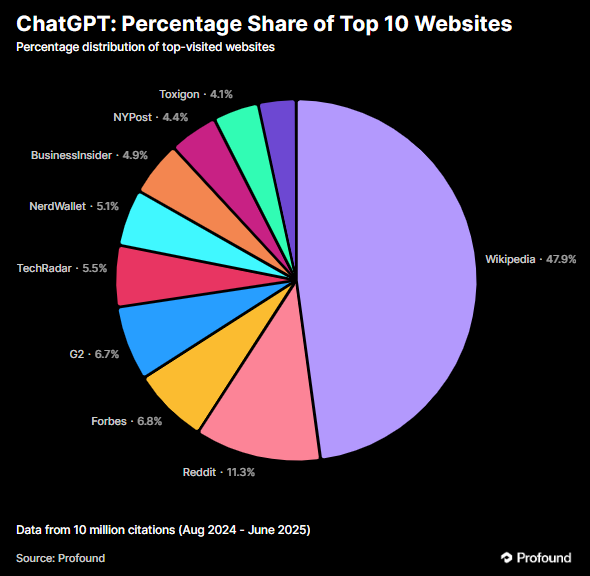
Google AI Overviews Tendencies: Google's AI tends to favour diverse professional sources, government and educational institutions, and industry-specific authoritative sites. The algorithm seems more democratic in its source selection compared to ChatGPT.

Perplexity's Unique Approach: What's interesting about Perplexity is its emphasis on community platforms like Reddit and forums, real-time information sources, and user-generated content. It's almost like it values fresh, conversational insights over traditional authority markers.

The Numbers That Keep You Up at Night
Let's talk about the market implications, because the financial projections are staggering. The multimodal AI search market is projected to grow from $1.4 billion in 2023 to $15.7 billion by 2030. That's a compound annual growth rate of 41.2%—the kind of growth that creates entirely new industries.
However, despite AI search traffic currently representing only 0.25% of total website traffic, some reports show conversion rates of 10%—significantly higher than traditional channels.
The Competitive Landscape
As you might expect, ChatGPT dominates the generative AI search market with 60.5% market share. Microsoft Copilot holds 14.3%, and Google Gemini captures 13.5%.

How Approach GEO vs Traditional SEO
Here is a simple comparison that's helped me explain the difference to clients and colleagues:
Focus On | Traditional SEO | My GEO Approach |
Primary Goal | Drive clicks and rank in SERPs | Maximize citations in AI responses |
Content Strategy | Keywords, meta tags, backlinks | Semantic richness, structured data |
Target Audience | Search engines and users | AI systems that synthesize answers |
Success Metrics | Rankings, CTR, organic traffic | Citation frequency, AI visibility score |
Final Thoughts on the GEO Revolution
Generative Engine Optimization represents the future foundation of digital visibility. The data is overwhelming, the growth trajectory is unprecedented, and the competitive advantage goes to those who act now.
The shift from SEO to GEO is happening faster than any previous digital marketing evolution we've witnessed. Organizations that begin implementing comprehensive GEO strategies now will be positioned to thrive as AI search achieves mainstream dominance.
The revolution is not coming—it is already here. The question is: are you ready to be part of it?
Questions I Get Asked Most Often
What's the real difference between SEO and GEO? Traditional SEO optimizes content to rank higher in search results to drive clicks, while GEO optimizes content to be cited and referenced in AI-generated responses. It's about authority and trustworthiness rather than rankings.
How quickly should businesses implement GEO strategies? Given that AI search traffic is growing 165 times faster than traditional search, it is suggested to begin implementing GEO strategies immediately. The competitive advantage goes to early adopters who establish citation authority before the market becomes saturated.
Which AI platforms should businesses prioritize for GEO? Based on the analysis, it is recommended to focus first on ChatGPT (60.5% market share), Microsoft Copilot (14.3%), and Google Gemini (13.5%), using platform-specific optimization strategies for each system’s unique citation preferences. Then, adapt to other platforms as needed.
What are the most effective GEO techniques? Research shows that:
statistics addition (40% improvement),
citations and quotations (35-40% improvement),
and authoritative content optimization (25-30% improvement)
are the most effective GEO techniques.
How to actually measure GEO success?
Tracking citation frequency across AI platforms,
visibility score in AI responses,
share of voice in AI results,
and citation authority quality.
Advanced analytics include response position, context quality, and competitive benchmarking.
Implementing A GEO Strategy For Your Company
GEO requires marketers to engage in a broad range of activities, including content creation, social media management, and systematic outreach. Increasing Google website authority, in particular, can be difficult for in-house marketing teams if they lack the necessary SEO and content marketing experience.
Many companies choose to partner with an agency to assist in executing the more complex parts of a GEO strategy. If you’d like to learn about how we can help you implement GEO, reach out here.
